
Analyst report · from T Mobile
Top 10 AI Infrastructure Questions Every CIO Should Be Asking
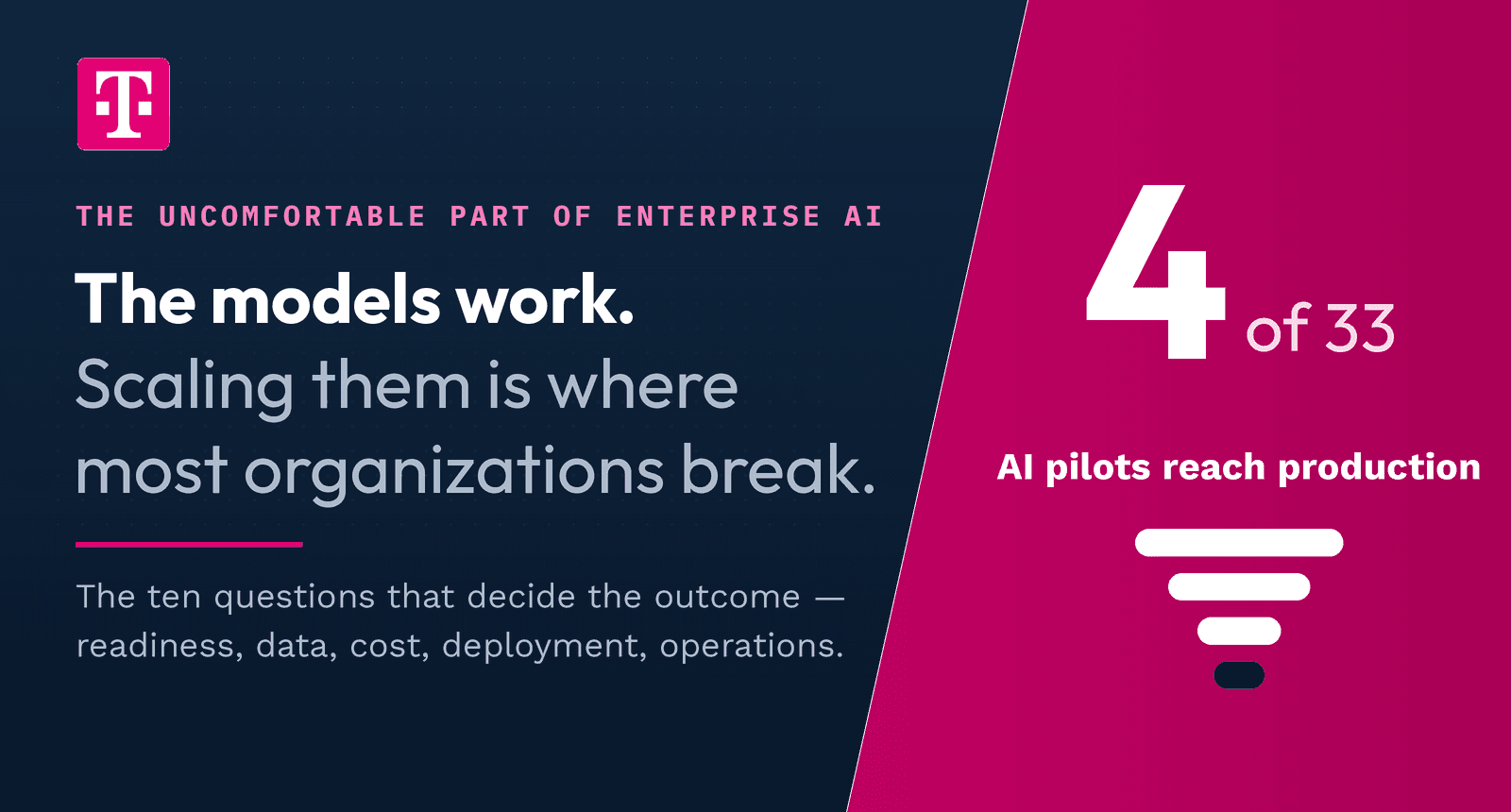
Only 4 of every 33 AI proofs-of-concept reach production (IDC, 2025). The other 29 stall — not because the model failed, but because no one asked the scaling questions early enough. This guide gives you the ten that
- Format
- Analyst report
- Published by
- T Mobile
- Category
- AI Strategy & Governance
- Added
- 5 Aug 2026
About this analyst report
Only 4 of every 33 AI proofs-of-concept reach production (IDC, 2025). The other 29 stall — not because the model failed, but because no one asked the scaling questions early enough. This guide gives you the ten that decide the outcome, with the evidence behind each.
The hard numbers
- 85% of AI project failures trace to poor data quality — Gartner
- 63% of organizations have no AI governance policy — IBM, 2025
- 28% of AI use cases fully meet ROI expectations — Gartner, 2026
What’s inside
- Whether you’re building AI experiments — or enterprise AI capability
- What happens to infrastructure when 100 users become 10,000
- Public, private, hybrid or sovereign: which workloads belong where
- The AI security and governance risks a traditional checklist won’t catch
- The true cost of AI in production — beyond the model
- Who operates it after go-live: the 70% of AI success most plans ignore
- Industrial AI: extending beyond the office into plant, warehouse and field
10-minute read. Written for CIOs, CTOs and infrastructure leaders across Singapore & APAC.
Listen or skim
Summaries are generated from this page’s text. Read the full piece for the detail.
Elsewhere in AI Strategy & Governance
See the category →
The State of AI Governance
The State of AI Governance: The Enterprise Governance Gap - Trillions of Tokens, Zero Governance explores how rapidly enterprise AI adoption is outpacing the controls needed to govern it. Based on anonymized production
AI Governance in Action
AI Governance in Action: A Strategic Guide is a practical ebook designed to help organizations understand, manage, and govern enterprise AI adoption. Using the fictional Kong Air case study, the guide explores
AI Governance Toolkit
Building AI governance one policy at a time invites gaps—and by the time you find them, the damage is done. A more effective path is to start deliberately, prove value quickly, and scale from there. Workiva's AI