
Whitepaper · from Check Point
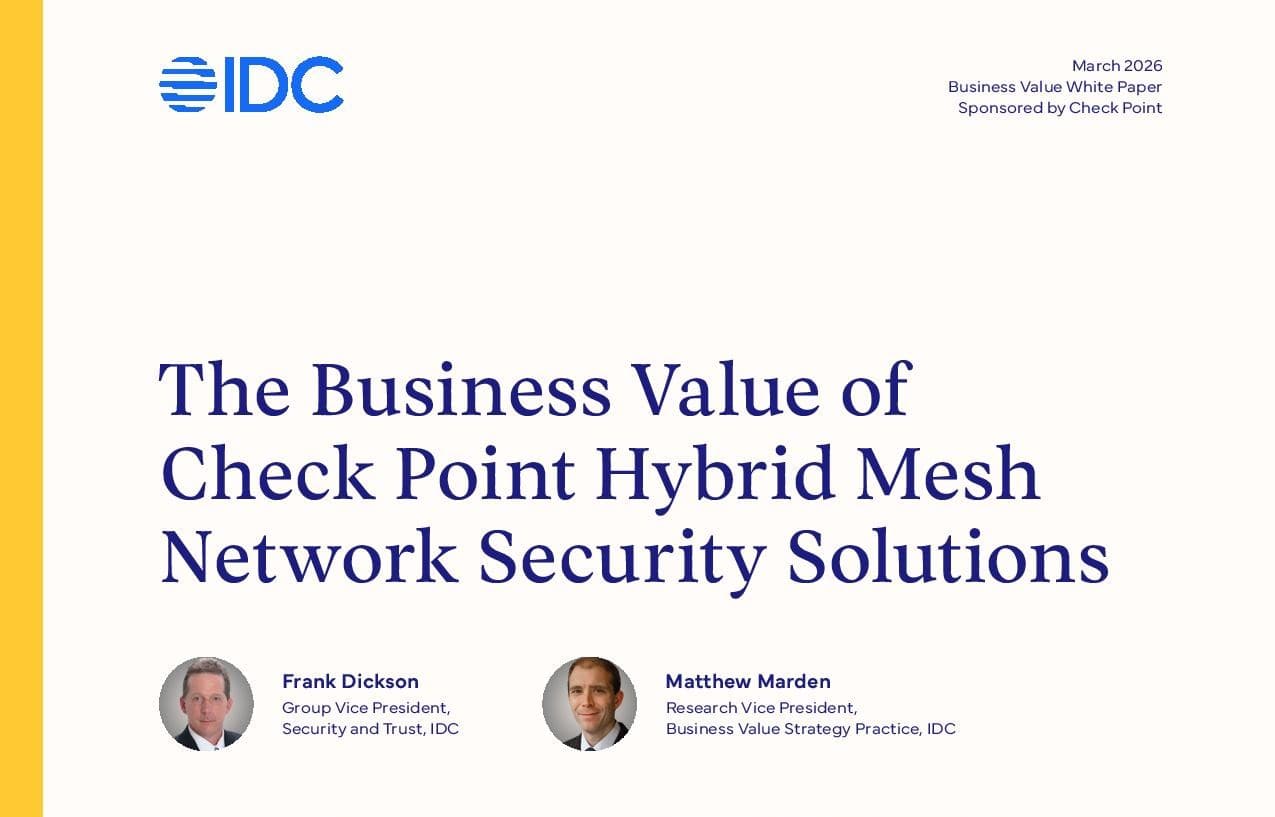
The Business Value of Check Point Hybrid Mesh Network Security Solutions
This document describes organizations that have deployed or expanded Check Point Hybrid Mesh Network Security (Check Point) solutions to protect hybrid, distributed IT environments. In doing so, they have improved
- Format
- Whitepaper
- Published by
- Check Point
- Added
- 14 Jul 2026
About this whitepaper
This document describes organizations that have deployed or expanded Check Point Hybrid Mesh Network Security (Check Point) solutions to protect hybrid, distributed IT environments. In doing so, they have improved security effectiveness, centralized policy and management across environments, reduced operational complexity, and achieved measurable gains in risk reduction, productivity, cost efficiency, and financial results.
IDC conducted in-depth interviews with organizations across multiple industry verticals to understand the business that Check Point has delivered. Interviewed organizations use Check Point to secure complex hybrid and multicloud environments, along with branch and perimeter networks and distributed workforces. They reported significant value from Check Point through improved security effectiveness, reduced security risk, increased operational efficiency, and optimized security-related costs. On average, IDC projects that these organizations will realize $5.99 million in annual benefits per organization ($108,900 per 1,000 IT assets secured).
The most significant sources of value include:
- Stronger security posture and threat prevention driven by improved threat detection and prevention across hybrid environments, reducing security incidents and their associated business impact
- Security team efficiencies as a result of greater visibility, policy management, and automation, which reduce manual effort and improve team productivity levels and coverage capacity
- Scalability and flexibility across environments to secure growing traffic volumes, cloud workloads, and distributed users without proportional increases in costs or staff time requirements
- Cost and resource optimization through tool consolidation and automation, enabling organizations to lower security costs while protecting more IT assets
Listen or skim
Summaries are generated from this page’s text. Read the full piece for the detail.
More from Check Point
All 11 →
Converging Connectivity & Security The Strategic Role of SD-WAN in Advanced Security Architectures
Modern enterprises need secure, high-performance connectivity without the complexity of traditional WAN architectures. This white paper explores how converging SD-WAN and SASE can simplify operations, strengthen
AI Security: The Next Critical Layer of SASE
AI is transforming the way employees work, accelerating productivity, innovation, and decision-making. But as AI tools, agents, and assistants become embedded across everyday workflows, they also introduce new security
The Repurposed Perimeter 5 Trends Reshaping Workforce Security
Today’s enterprises operate far beyond the traditional network perimeter, spanning cloud, remote users, and hybrid environments. The Repurposed Perimeter white paper explains why legacy perimeter security no longer
Elsewhere in Cybersecurity & Threat Management
See the category →
Cyber Threat Landscape Report 2026
Frontline intelligence on the cyber risks shaping ASEAN, Australasia, and East Asia.
F5 named an innovation, market, and product leader in KuppingerCole's GenAI Defense Leadership Compass
In their inaugural guide addressing the nascent and evolving space of AI security, KuppingerCole has released its Generative AI Defense Leadership Compass, naming F5 as an Innovation Leader. At F5, we are thrilled and
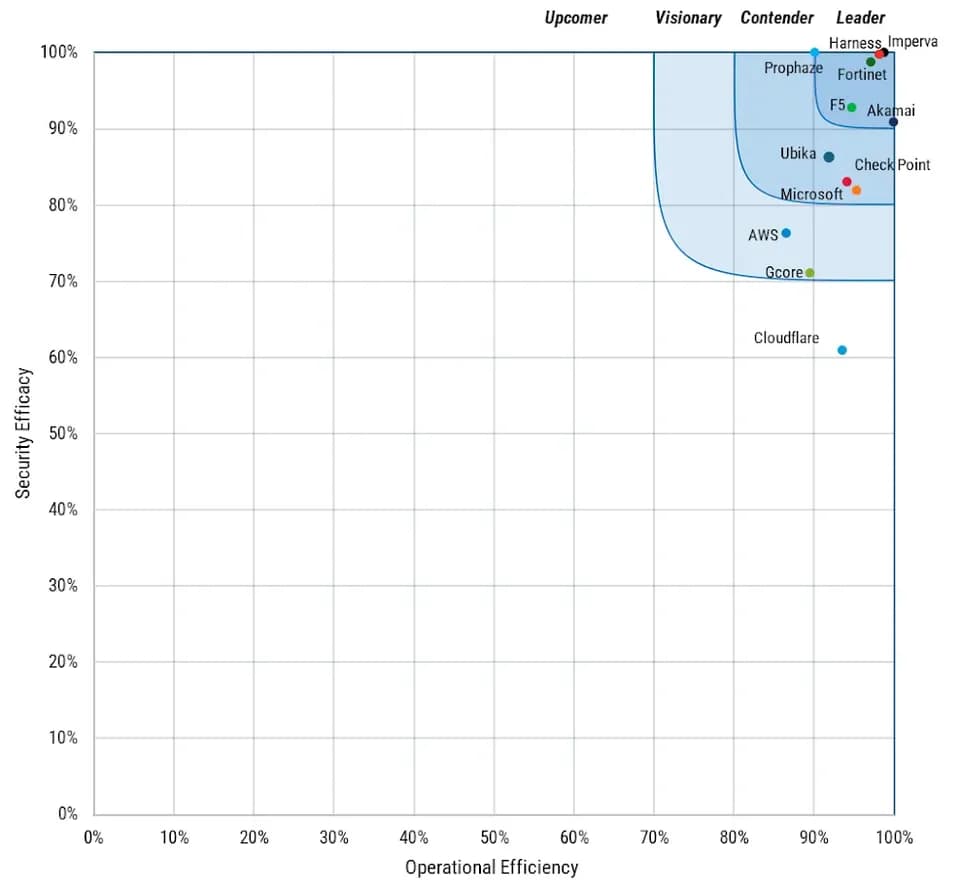
F5 named a leader in SecureIQLab’s Cloud WAAP v5.0 CyberRisk Validation Comparative Report
In SecureIQLab’s recent “Cloud WAAP v5.0 Comparative Report,” F5’s Distributed Cloud WAAP was placed in the Leader tier of the CyberRisk Ripple—the report's highest classification, reserved for solutions scoring well on