
Whitepaper · from Pingidentity
The Battle for Balance: Minimizing Friction Without Sacrificing Security
Modern IAM eliminates friction and boosts security with adaptive, seamless access—reducing IT overhead, user frustration, and compliance risk.

- Format
- Whitepaper
- Published by
- Pingidentity
- Category
- Identity & Data Protection
- Added
- 28 May 2026
About this whitepaper
Modern IAM eliminates friction and boosts security with adaptive, seamless access—reducing IT overhead, user frustration, and compliance risk.
Listen or skim
Summaries are generated from this page’s text. Read the full piece for the detail.
More from Pingidentity
All 7 →
How to Plan Your IAM Future with PingOne Advanced Identity Cloud
See how top enterprises modernized IAM to boost security, reduce costs, and improve digital experiences.
Modern Identity: Serious Verification, Seriously Valuable
Get our summary to build a business case your CISO and CIO will love:
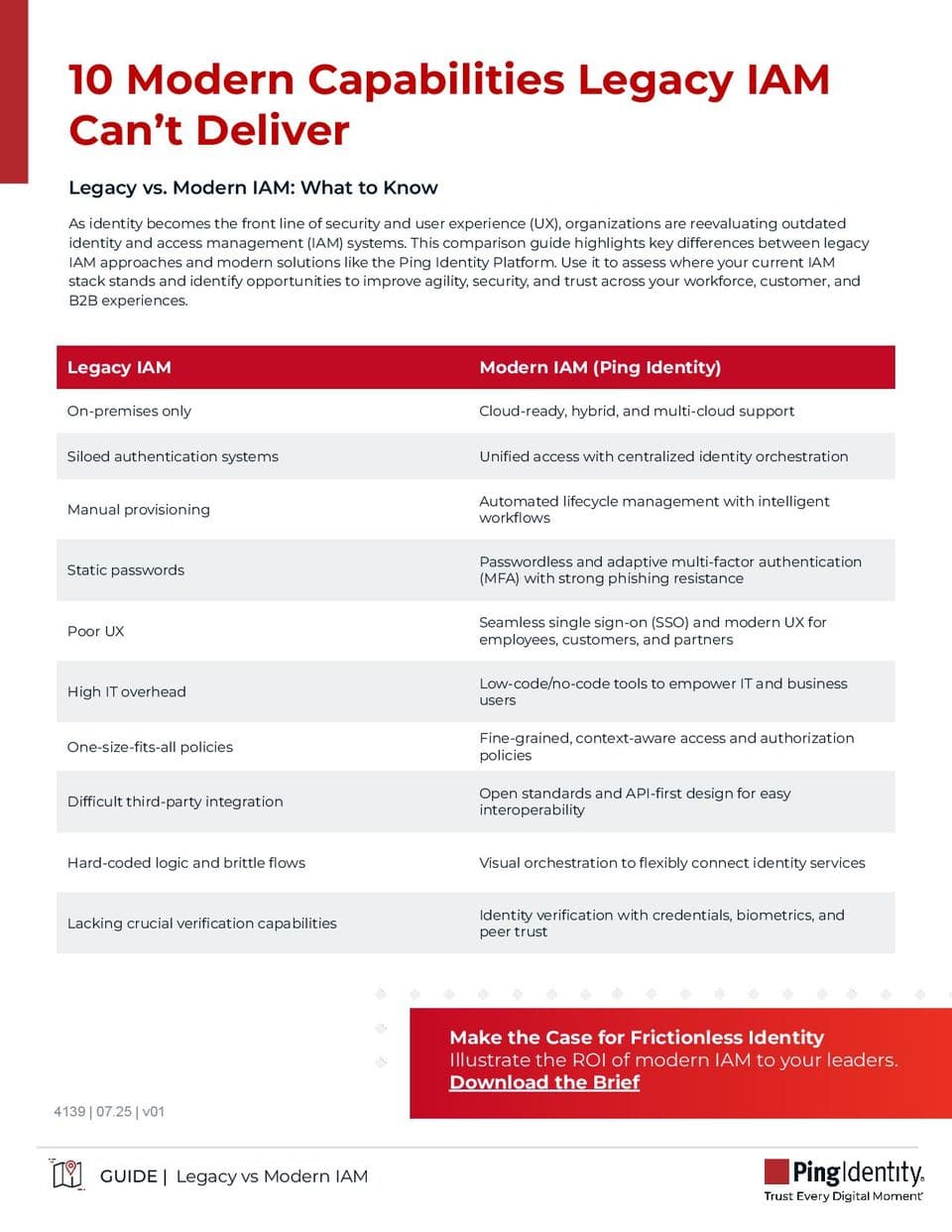
10 Modern Capabilities Legacy IAM Can’t Deliver
Legacy identity and access management (IAM) systems weren’t built for today’s digital reality. Siloed tools, manual provisioning, and static passwords slow business down, frustrate users, and leave organizations exposed
Elsewhere in Identity & Data Protection
See the category →
F5 achieves 97.09% total security protection score from SecureIQLab for WAAP and AI Guardrails solution
In today’s fast-changing technological landscape, applications and how we secure them are undergoing a major shift. Artificial intelligence (AI) is at the forefront of innovation, revolutionizing how apps are designed

CIT Cornerstone: Identity Under Attack
This report examines how identity systems are being targeted and abused, and why identity has become a critical control point for modern attacks. It highlights common identity-driven tactics, the business impact of

The SMB Guide to Protecting Business
The SMB Guide to Protecting Business is a hands-on resource for small and mid-sized teams that rely on SaaS apps and want stronger, simpler data protection. It breaks down why built-in retention and recycle bins aren’t