
Analyst report · from Palo Alto Networks
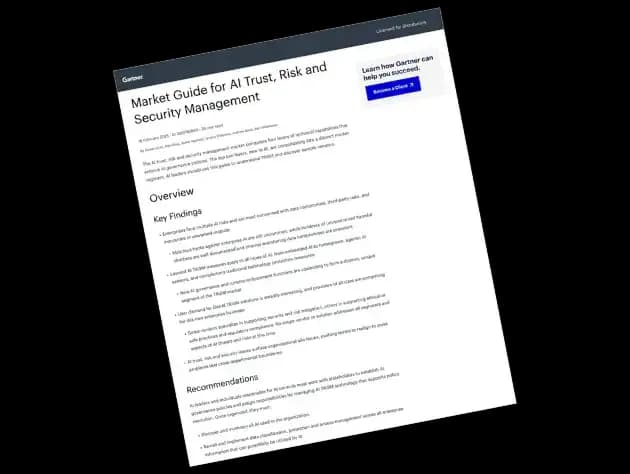
Gartner Market Guide - See how the TRiSM framework is designed to help companies securely develop and use AI applications.
What do you need to secure AI use and deployment?
- Format
- Analyst report
- Published by
- Palo Alto Networks
- Category
- AI Strategy & Governance
- Added
- 8 Jun 2026
About this analyst report
What do you need to secure AI use and deployment?
- Through 2026, at least 80% of unauthorized AI transactions will be caused by internal violations of enterprise policies concerning information oversharing, unacceptable use or misguided AI behavior rather than malicious attacks.
- In total, 318 senior executives participated, who were involved in data security across organizations of different industries, geographies and sizes.
- By 2028, consolidated and dedicated information governance teams consisting of representatives from data and analytics, digital workplace, and security and compliance will exist in 25% of large organizations, up from less than 1% in 2023.
Understand why the AI TRiSM framework matters.
Listen or skim
Summaries are generated from this page’s text. Read the full piece for the detail.
More from Palo Alto Networks
All 27 →
SecOps Transformation in Action
See how Cortex XSIAM meets the challenge for the Palo Alto Networks SOC.
Proactively find, prioritize and mitigate risk to prevent breaches
Discover every vulnerability across your network, cloud and endpoints with Cortex® Exposure Management.
See Cortex XSIAM through SANS' unbiased lens
Learn how XSIAM's AI-driven platform can transform your SecOps.
Elsewhere in AI Strategy & Governance
See the category →
The State of AI Governance
The State of AI Governance: The Enterprise Governance Gap - Trillions of Tokens, Zero Governance explores how rapidly enterprise AI adoption is outpacing the controls needed to govern it. Based on anonymized production
AI Governance in Action
AI Governance in Action: A Strategic Guide is a practical ebook designed to help organizations understand, manage, and govern enterprise AI adoption. Using the fictional Kong Air case study, the guide explores
AI Governance Toolkit
Building AI governance one policy at a time invites gaps—and by the time you find them, the damage is done. A more effective path is to start deliberately, prove value quickly, and scale from there. Workiva's AI