
Whitepaper · from Cloudflare
DORA compliance: Fortifying financial security and resilience with Cloudflare
The Digital Operational Resilience Act (DORA) is a major new piece of European Union (EU) legislation that aims to strengthen the cyber security and resilience of financial entities (FEs). European lawmakers originally
- Format
- Whitepaper
- Published by
- Cloudflare
- Category
- Finance, ERP & Operations
- Added
- 28 May 2026
About this whitepaper
The Digital Operational Resilience Act (DORA) is a major new piece of European Union (EU) legislation that aims to strengthen the cyber security and resilience of financial entities (FEs). European lawmakers originally approved DORA in late 2022, and the major financial regulators have been busy crafting implementing regulations. The law came into full application on January 17, although some of the implementation still needs to be finalized.
DORA applies to a range of FEs, including banks, credit institutions, and investment firms. Notably, it also regulates some newer categories of FEs, such as crowdfunding platforms and crypto-asset service providers.
The regulation aims to create a more consistent approach to digital operational resilience across the European Union (EU) financial sector and reduce the impact of information and communication technologies (ICT)-related disruptions on financial stability. DORA requires financial enterprises to:
- Implement a comprehensive ICT (Information and Communication Technology) risk management framework
- Report major ICT-related incidents to relevant authorities
- Conduct regular digital operational resilience testing, including vulnerability assessments and penetration tests
- Manage third-party ICT risks through enhanced oversight of critical ICT service providers
- Share threat intelligence information with other financial entities
To comply with DORA, FEs first need to identify key challenges to meeting DORA requirements, then formulate a strategy that addresses essential requirements without adding significant complexity.
Listen or skim
Summaries are generated from this page’s text. Read the full piece for the detail.
More from Cloudflare
All 13 →
Minimize risks and complexity of agentic AI adoption
Organizations are racing to launch AI agents. In fact, 95% of companies plan to adopt agentic AI even faster than GenAI.*
How to prepare your agency for responsible AI adoption
The federal government is under pressure to move faster, cut costs and prove impact. As the White House prioritizes military readiness, border security and boosting efficiency, agencies must still deliver secure digital

Preparing for the future of AI
Over the last few years, artificial intelligence (AI) went from science fiction to everyday fact. In 2024, 65% of companies surveyed by McKinsey said they were regularly using AI, and 75% predicted generative AI would
Elsewhere in Finance, ERP & Operations
See the category →
The State of Generative AI in the Office of the CFO
Generative AI is delivering measurable results for finance teams, with 88% of users reporting increased ROI. But as adoption outpaces policy, the risk of ungoverned AI usage is growing. The State of Generative AI in the
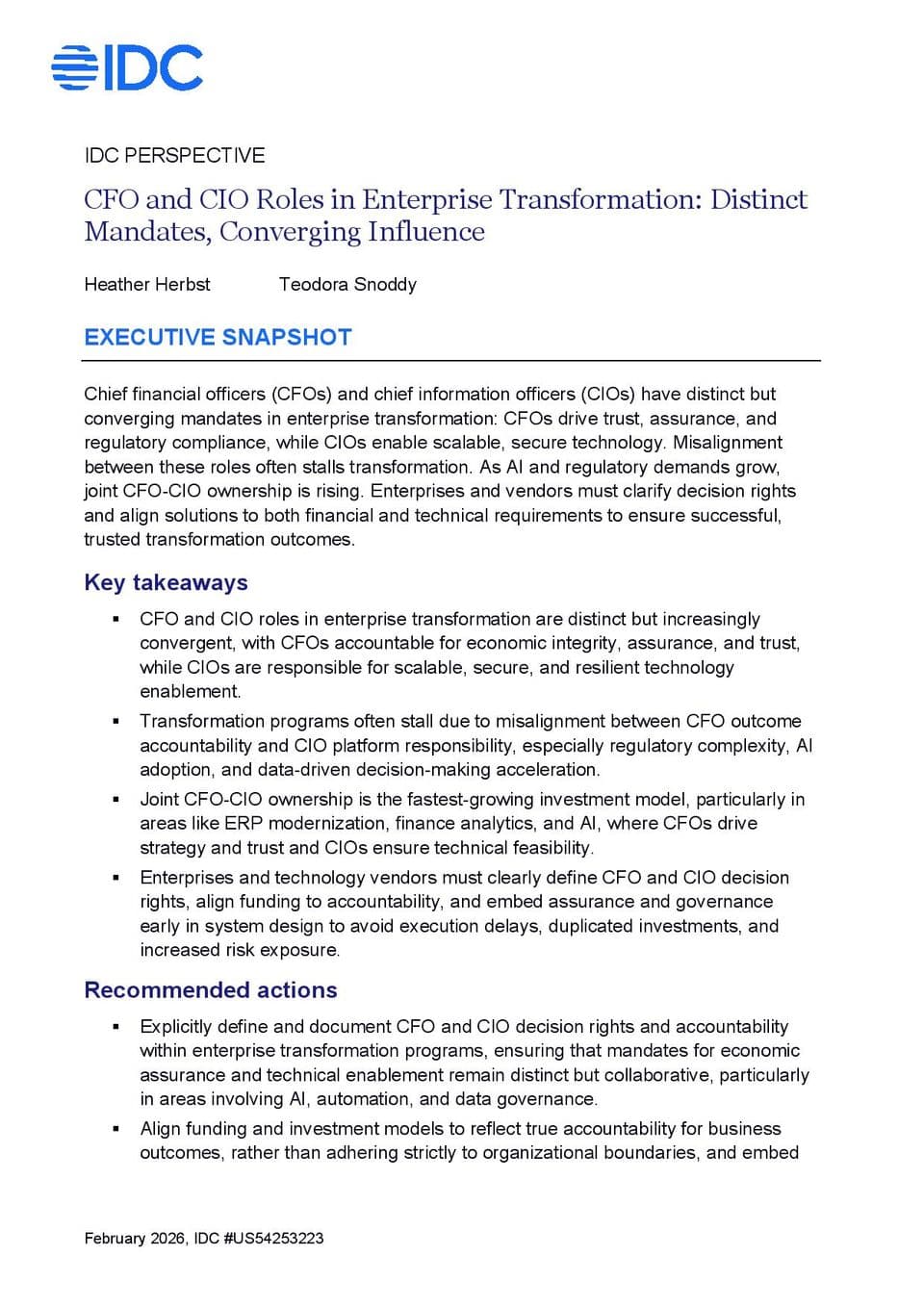
CFO and CIO Roles in Enterprise Transformation: Distinct Mandates, Converging Influence
AI adoption, regulatory complexity, and demands for data integrity are reshaping how enterprises make technology decisions. According to a new IDC Perspective, the days of siloed tech ownership are over. The most
2026 MidYear Executive Benchmark Survey: The Verification Gap
Artificial intelligence is transforming the enterprise, but data realities are struggling to keep up with executive ambitions. Investors are watching closely—89% are concerned about AI accuracy in disclosures. The 2026